


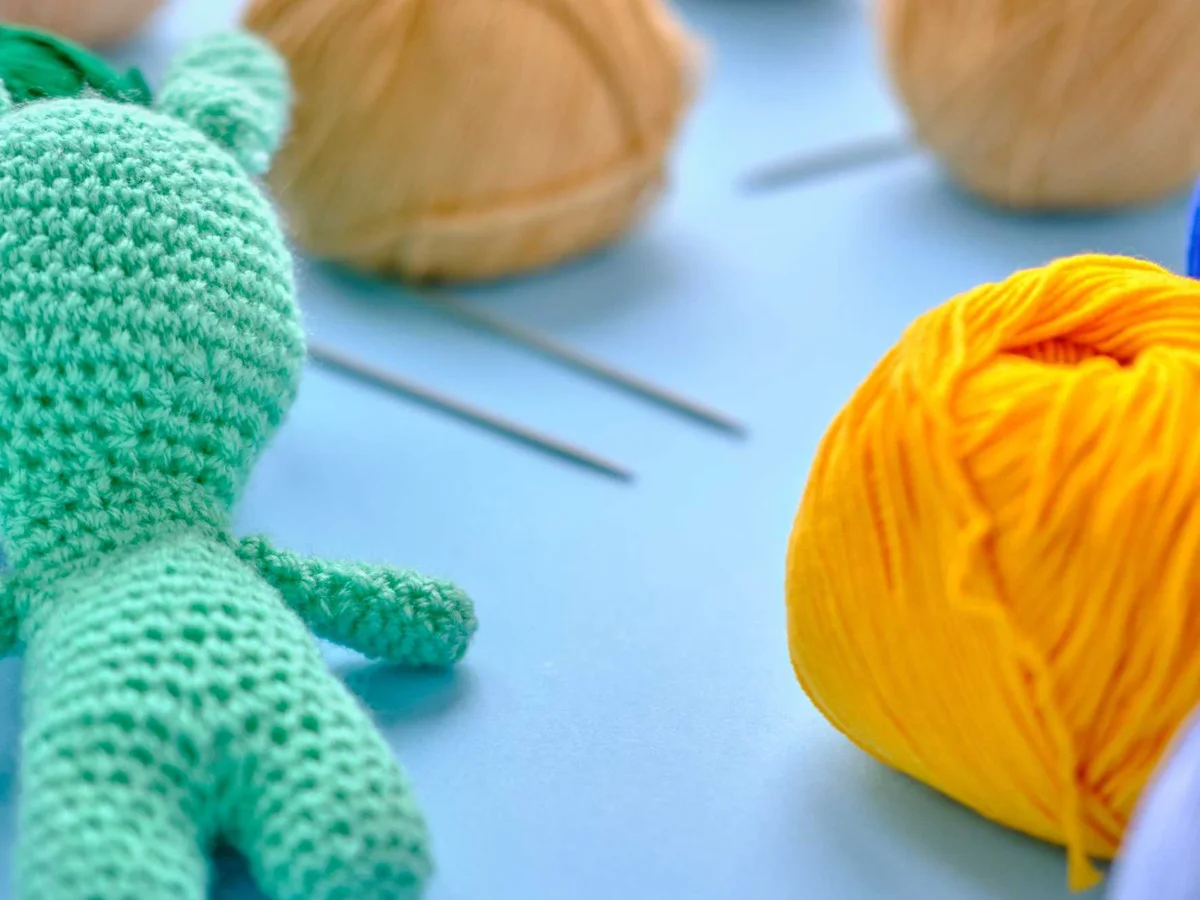
Knitting needs remarkably little to begin: two needles and a ball of yarn. Everything sold as a beginner kit is a convenience rather than a requirement.
What to buy
A pair of needles, around 5mm (US 8). This is the sweet spot for learning – large enough to see what your hands are doing, small enough to feel like knitting rather than wrestling.
Bamboo or wood, not metal. Wood grips the yarn slightly, and that friction means fewer stitches sliding off while you are still learning to control the work. It makes a real difference in the first fortnight.
A ball of smooth, light-coloured worsted weight yarn. Light so you can see the stitches, smooth so the stitch structure is visible, worsted because it works at a satisfying pace.
Avoid dark, fuzzy, novelty and variegated yarns entirely at first. They hide the stitches, and being unable to see what you have done is the fastest route to giving up.
A blunt tapestry needle for weaving in ends. Under a pound, and you will need it at the end of the first project.
That is the whole list. Stitch holders, cable needles, point protectors and row counters are all useful eventually and none of them are needed now.


Kits
Beginner kits bundle needles, yarn and an instruction booklet. They are convenient and they are usually more expensive than buying the parts separately.
Where a kit earns its price is if the booklet is genuinely good, or if it is a gift and you want it to look like one. If you are buying for yourself, a pair of bamboo needles and one ball of yarn from a local shop costs less and gets you the same place.
What to learn first
Casting on, the knit stitch, the purl stitch, and binding off. Those four things make almost everything else. Garter stitch is nothing but knit; stocking stitch is knit and purl alternating; ribbing is the two mixed within a row.
Do not try to learn cables, colourwork or lace in the first month. They are not harder in principle, but they compound small errors, and you want your tension settled first.
What to make first
Something flat where the fit does not matter. A dishcloth in cotton, or a simple scarf.
A scarf teaches consistency over a longer piece and is genuinely useful at the end. A dishcloth finishes in an evening, which matters more than it sounds – the first completed object is what makes you want to start a second.
Do not start with a hat. Hats need gauge to be right and are worked in the round, and a first hat that fits nobody is a discouraging thing.
Expect the first rows to be bad
Everyone’s early tension is uneven and their edges are ragged. It settles on its own, faster than you expect, and no amount of unpicking accelerates it.
Finish the thing, however it looks. The second project will be visibly better than the first.
