


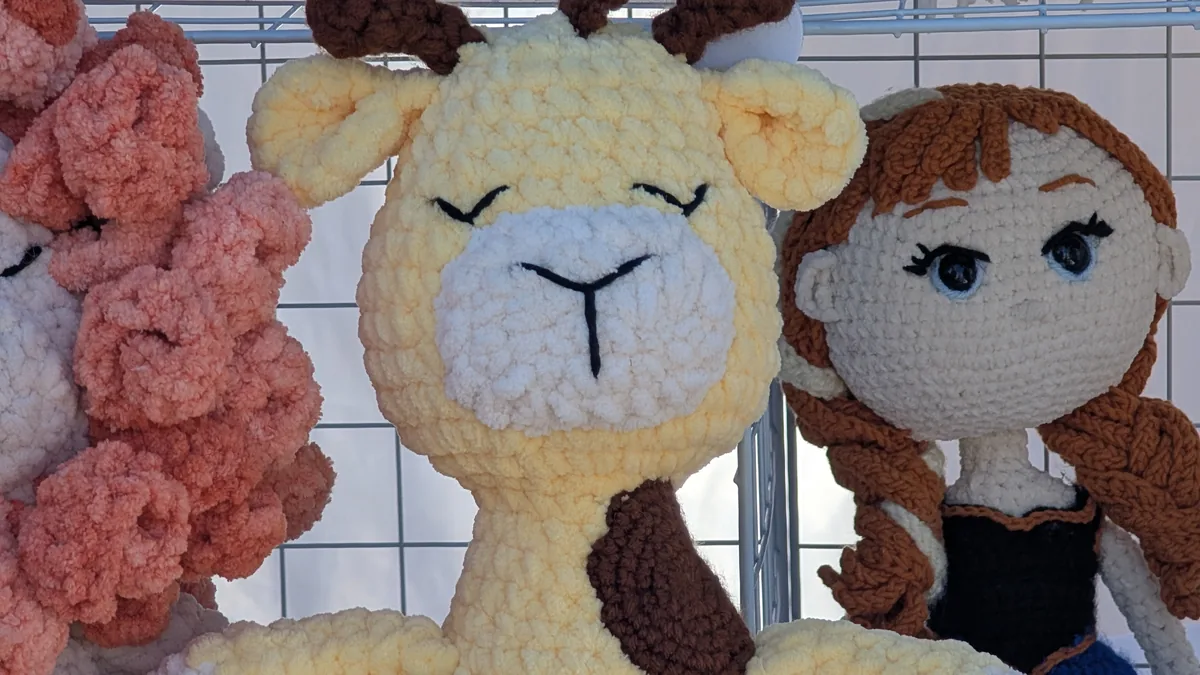
Pick one of these up and the first thing you notice is that it does not feel handmade. It feels like something off a shop shelf – dense, heavy, velvety, the kind of toy a child immediately refuses to give back.
That is almost entirely the yarn.
What chenille yarn actually is
Chenille blanket yarn is a polyester yarn built as a core with short fibres bound along it, which is what gives it that velvet pile. Sold as super bulky or jumbo, it works up fast and produces a fabric with no visible stitch texture at all.
For toys, that has one enormous advantage and one real cost.
The advantage: it forgives everything. Uneven tension, a stitch worked into the wrong loop, a slightly wobbly increase round – the pile swallows all of it. A beginner’s chenille plush and an expert’s chenille plush look far more alike than their worsted-weight equivalents would.
The cost: you cannot see what you are doing. Counting stitches on chenille is genuinely difficult, finding the last stitch of a round is worse, and frogging a mistake sheds fibre and leaves the yarn looking chewed.
The practical answer is to stop relying on your eyes. Use a stitch marker in the first stitch of every round and move it as you go, and count by feel, pinching each stitch rather than looking for it. Anyone who has worked a dark textured stitch pattern already knows the feeling.
Go down a hook size, then go down again
The yarn band on a jumbo chenille will suggest a very large hook, because it assumes you are making a blanket and want drape.
For a toy you want the opposite. Stuffing must not show through, and the fabric needs enough body to hold a head up. Most makers drop two or three sizes below the band recommendation. The fabric should feel firm and slightly stiff off the hook – if it feels soft and open, it is too loose, and the first time it is squeezed you will see white polyfill through the gaps.
A warning worth taking seriously: chenille is hard on your hands. It has very little give, the fabric is tight by design, and the pieces are big. This is not the project to make in one sitting. Work in shorter stretches than you would with wool, and stop when your hand starts complaining rather than after.
Putting a face on fuzzy fabric
This is where chenille plush gets its own set of rules.
Embroidery beats safety eyes on a fuzzy surface for anything soft-featured. The sleeping eyes and the little stitched nose on the giraffe above are worked in black yarn directly onto the pile, and they read beautifully – closed eyes are also very forgiving, because there is no symmetry to get wrong. Use a smooth yarn rather than more chenille, or the line disappears into the fluff.
If you do want open eyes, you have two options. Safety eyes push through chenille fine, but you have to part the pile to seat them flush or they sit proud and look startled. Or work the eye area as a separate flat patch in a smooth yarn – which is exactly what the doll on the right does, with a face worked in standard yarn and the chenille kept for the hair and the body.
Trim the pile around embroidered features. A tiny snip with sharp scissors around a stitched mouth makes it legible instead of hazy. Go slowly; it does not grow back.
Washing, safety and the resale question
Polyester chenille washes well, which is a large part of why it has taken over the plush market. Cold, gentle cycle, in a pillowcase or mesh bag, and lay flat to dry – a tumble dryer will mat the pile and you will not get it back.
If the toy is for a baby or a toddler, embroider the face and skip safety eyes and wire entirely, and check that nothing is sewn on in a way that a determined child could work loose. Any separate limb should be attached with the same yarn and a good few passes, not a single seam.
And if you are making these to sell, price the yarn honestly. A large chenille plush can eat three or four skeins, and jumbo chenille is not cheap – makers routinely undercharge because the work goes quickly and they forget the materials did not.
What is chenille blanket yarn best for?
Plush toys, baby blankets and anything where softness matters more than stitch definition. It hides uneven tension, which makes it very beginner-friendly, and it produces a dense, velvety fabric that feels shop-bought. It is a poor choice for lace, for detailed amigurumi features, or for anything where you want the stitch pattern itself to be the decoration.
What hook size should I use for chenille yarn toys?
Two to three sizes smaller than the yarn band suggests. The band assumes a blanket and wants drape; a toy needs a fabric tight enough that polyester stuffing cannot show through the gaps. The finished fabric should feel firm off the hook.
How do you count stitches in chenille yarn?
By feel rather than by sight. Put a stitch marker in the first stitch of each round and move it every round without exception – with chenille there is no recovering your place by looking at the fabric. Pinch each stitch between finger and thumb as you count.
Can you machine wash crochet chenille plush toys?
Yes, on a cold gentle cycle, ideally inside a pillowcase or mesh laundry bag. Lay it flat to dry. Keep it out of the tumble dryer – heat mats the pile permanently and the velvety texture is the whole point of the yarn.
The short version
Chenille does the softness for you and hides your tension mistakes, so it is a genuinely good beginner yarn for toys – as long as you go down several hook sizes, mark every round, embroider the face rather than relying on safety eyes, and accept that you cannot frog it cleanly.
Working with the same yarn at blanket scale instead? See chunky chenille blankets.


