


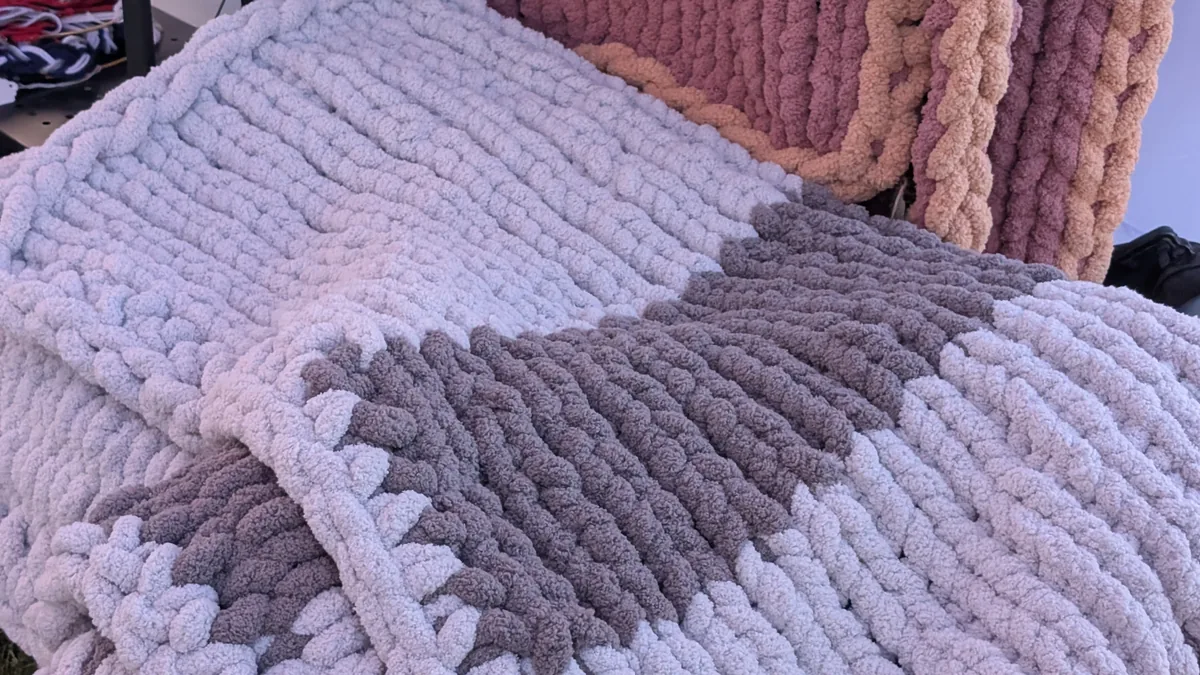
Every craft fair table has them now: enormous, braided-looking throws in soft neutrals, folded so the colour blocks show. They photograph well, they sell fast, and they look like they took a week.
Most of them took an evening.
The braid tells you how it was made
That rope-like surface is the tell. It is not a crochet stitch and it is not conventional knitting – it is the look of very large loops pulled through each other, and there are three common ways to get there.
-
Finger knitting or arm knitting with jumbo chenille. No tools at all: your hand is the needle. Fastest, loosest, and the easiest to make lopsided, because your hand span is the gauge and it drifts as you get tired.
-
Loop yarn (sold as Bernat Blanket EZ and similar), which comes with the loops pre-made. You simply pull each loop through the one below with your fingers. This is the one behind a great many of the blankets you see for sale – it needs no skill at all beyond counting, which is why it turns up at every fair.
-
A jumbo hook or giant needles with ordinary chunky chenille. Slower, far more even, and the only one of the three that gives you real control over gauge and shaping.
None of these is cheating. But if you want a throw that lies flat and has straight edges, the hook or needles will get you there and the arm-knit version probably will not.
Buy more yarn than you think
This is the part that catches everyone.
A generous adult throw in jumbo chenille is a serious amount of yarn – commonly six to ten skeins depending on the brand and how big you go, and the skeins are not cheap. The blanket looks quick because it is quick, but the materials cost is the real story, which is why these sell for what they do.
Two practical consequences. First, buy it all at once and check the dye lot – chenille shows a lot shift badly across a large flat area, much more than a textured wool would. Second, do the arithmetic before you start rather than a third of the way in, because running out mid-blanket with a discontinued colour is a genuinely miserable way to spend an afternoon.
If you would rather start small and cheap, an ordinary acrylic blanket is a better first project, and a baby blanket is a better first chenille one – same technique, a third of the yarn.
Colour blocking without the tangle
The grey-and-cream throw above is doing something simple and effective: large blocks of two neutrals, meeting in a straight line, with no gradient and no fuss.
A few things make that work.
Change colour at the edge, not the middle. The join is invisible at the selvedge and obvious in the field.
Pick colours at the same value, or deliberately far apart. Two mid-tones that are close but not equal look like a mistake. Grey against cream works because the contrast is decisive.
Leave long tails and weave them in with your fingers. Chenille does not need a needle – you can bury a tail inside the body of a jumbo stitch and it will stay, which is one of the small mercies of this yarn.
Resist the ombre. Three or four colours blending through a large throw sounds lovely and usually reads as muddy at this scale. The blankets that sell are almost always one or two colours.
How many skeins do I need for a chunky chenille blanket?
For a generous adult throw, plan on roughly six to ten jumbo skeins depending on the brand and the finished size; a baby blanket is closer to two or three. Check the specific yarn’s yardage rather than trusting a general number, buy it all in one dye lot, and buy one more than your estimate.
What is the difference between loop yarn and regular chenille yarn?
Loop yarn arrives with the loops already formed, so you make the blanket by pulling loops through each other with your fingers – no hook, no needles, no stitch knowledge. Regular chunky chenille is ordinary yarn that happens to be very thick, and you crochet or knit it as usual. Loop yarn is faster and needs no skill; regular chenille gives you far more control over gauge, shape and edges.
Do chunky chenille blankets shed or pill?
Good quality polyester chenille does not shed much, but it can pill where it rubs, and worming – where a strand works loose and stands proud of the surface as a little loop – is the common complaint. Tug a worm gently back into line rather than cutting it. Washing cold and drying flat keeps the pile intact.
Can you wash a chunky chenille blanket?
Yes. Cold water, gentle cycle, and lay it flat to dry. It will be extremely heavy when wet, so support the whole thing when you move it or you will stretch it out of shape. Keep it out of the tumble dryer; heat mats the pile and the softness does not come back.
The short version
Loop yarn if you want one by Saturday, a jumbo hook if you want one that lies flat. Two colours, blocked, changing at the edge. Buy all the yarn at once in one dye lot, and budget for more of it than seems reasonable.
Same yarn, smaller scale: chenille plush toys.


