


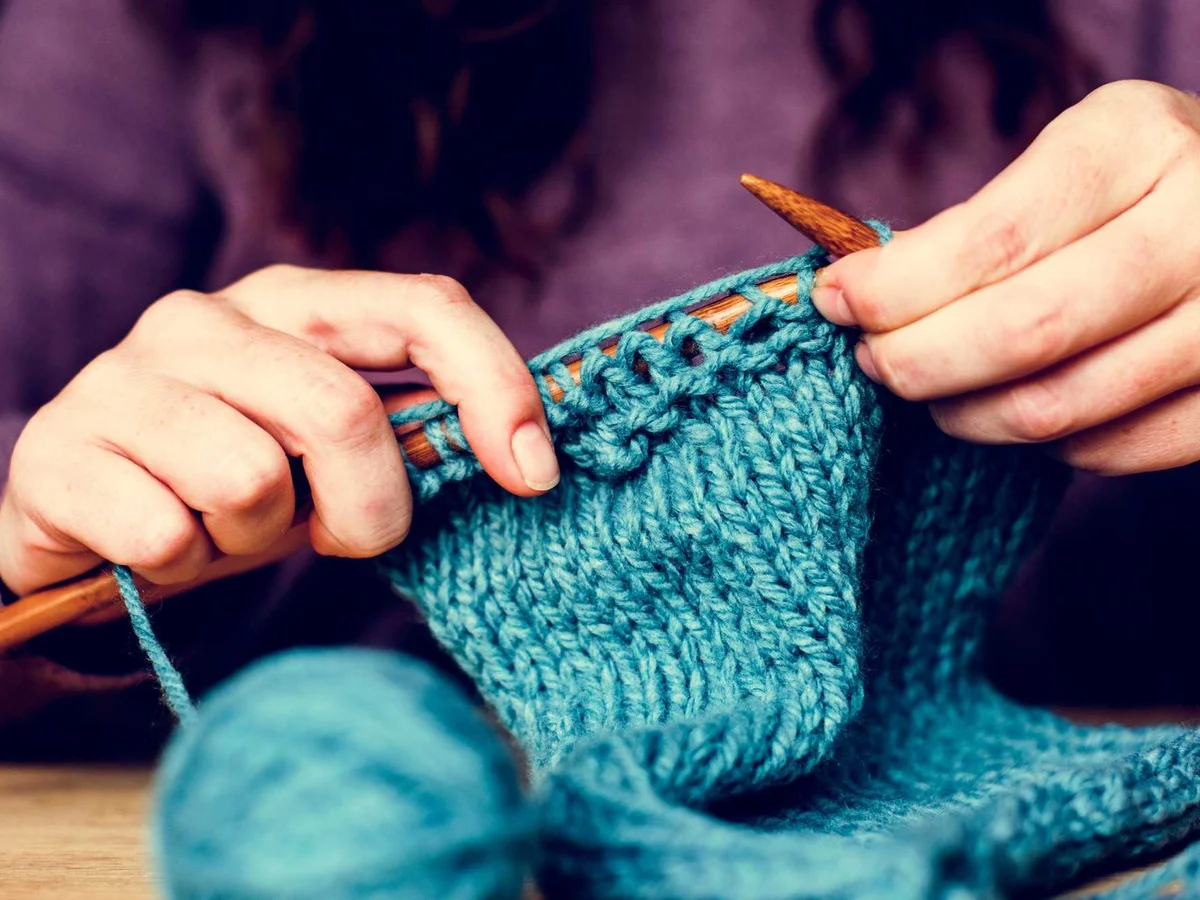
If you are new to knitting you are probably curious about the basics before taking lessons. Knitting is a hobby that is enjoyable, requires a certain steadiness, and gives you a real sense of achievement when a project is finished.
What knitting is
A craft in which two needles and yarn are used to make fabric from a continuous thread.
The key thing to understand is that a knitted fabric is one long strand looped through itself many thousands of times. Every stitch holds the one above and is held by the one below. That is why a dropped stitch runs – the loop below has nothing holding it any more.
Understanding that makes a great deal of knitting behaviour stop seeming arbitrary.
What you need
Needles around 5mm (US 8), in bamboo or wood rather than metal – wood grips slightly, so fewer stitches slide off while you are learning.
Smooth, light-coloured yarn in a medium weight. Light and smooth so you can see the stitches. This matters more than any other purchasing decision.


A blunt tapestry needle to weave in ends at the finish.
That is the whole list.
The four things to learn
Casting on. Making the first row of stitches. Keep it loose.
The knit stitch. Worked on every row it produces garter stitch, which lies flat and is perfectly good fabric.
The purl stitch. The knit stitch mirrored. Alternating knit and purl rows gives stocking stitch.
Casting off. Finishing so it does not unravel. Also keep it loose.
Those four are enough to make a great many things, and they can be learned in a day.
Your first project
Something flat where the fit does not matter. A dishcloth or a simple scarf in garter stitch.
A dishcloth finishes in an evening, and finishing something is what makes you want to start the next one.
Avoid hats and anything fitted at first. Those need correct gauge, and a first attempt that fits nobody is discouraging in a way a slightly wonky dishcloth is not.
What to expect
Uneven tension and ragged edges. Everybody’s first rows are like that, and it settles within a couple of projects without any particular effort.
Count your stitches at the end of every row for the first ten rows. Accidentally adding stitches at the edges is the most common beginner problem, and catching it early saves unpicking.
Knitted gifts
Once you can knit a scarf you can make a gift almost anyone will use. Scarves fit everybody, need no measurements, and show off a nice yarn.
They remain one of the best things a new knitter can make for someone else.

