


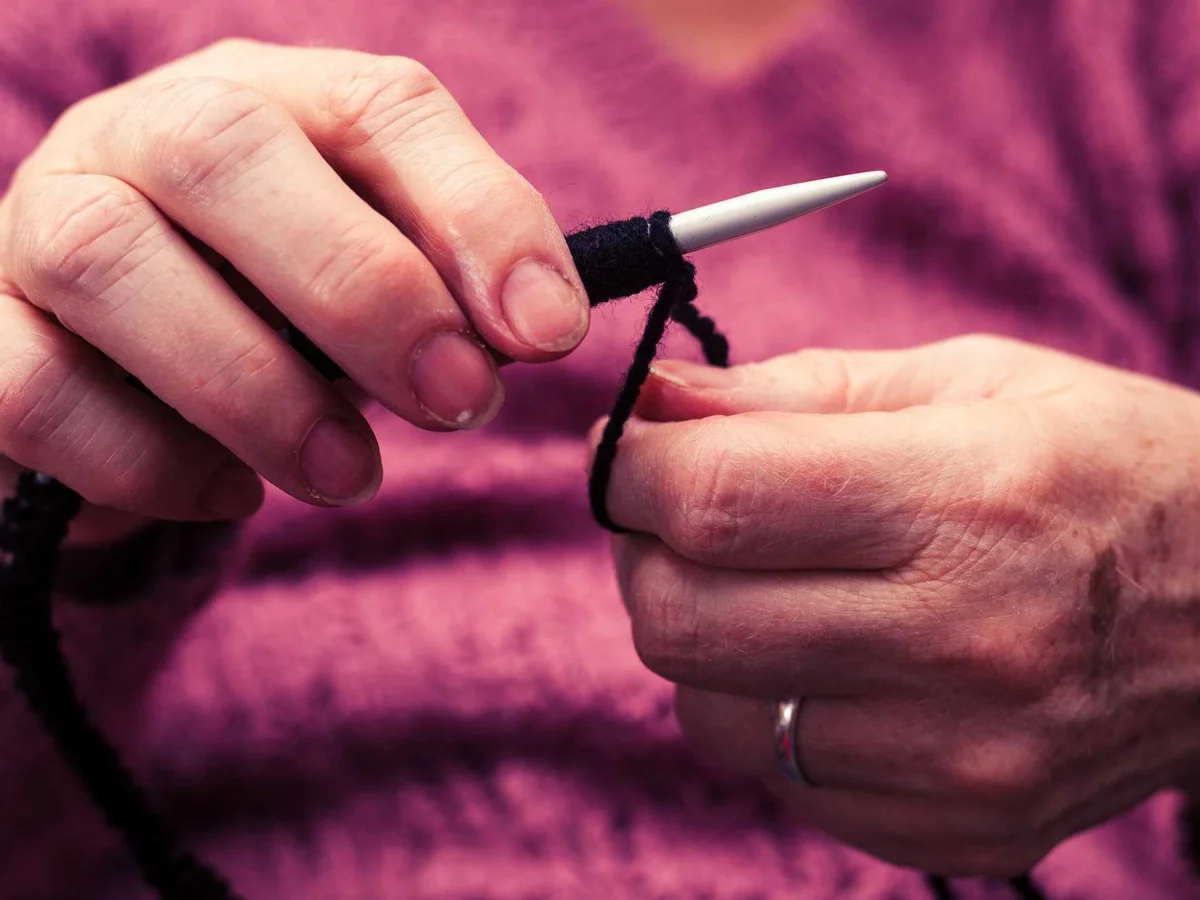
There are a great many knitting patterns available. Some people write their own, some borrow from friends and family, and they can be bought cheaply from craft shops or found online.
Whichever you use, the pattern will specify a yarn – and knowing how closely to follow that is worth understanding.
Match the weight first
This is the number that decides whether the finished item comes out the right size at all.
Weight is the thickness of the yarn, and it determines your stitch count per inch. Substituting a chunky for a DK will not give you a slightly different garment; it will give you one that is wrong in every dimension, and no needle adjustment fixes it.
Compare yardage rather than ball weight. Two 100g balls can hold very different lengths depending on fibre, and the pattern needs a length of yarn.
Then match the fibre
The part people skip, and it explains most cases where a garment hits the stated gauge and still looks wrong.


Fibre determines how the fabric behaves:
Wool is springy and elastic. It holds ribbing and cables, keeps its shape, and recovers when stretched.
Cotton is heavy with no memory. It drapes and it grows with wear.
Alpaca and silk are fluid and lustrous, with even less recovery.
Acrylic is hard-wearing and washable, sitting somewhere in the middle.
A cabled sweater designed in wool and knitted in cotton will have flat sagging cables at exactly the right gauge, because cotton cannot hold the texture.
Then think about what it has to do
Washed often? It must be machine washable, whatever the label says you could do carefully. Children’s clothes, socks and blankets all fall here.
Worn against skin? Softness overrides everything else. Test against your neck or the inside of your wrist rather than your fingers.
Hard wear? Socks and mittens want something firmly spun with nylon in the blend.
Thickness and warmth
If you want a garment extra thick and warm, the instinct is to use a heavier yarn. Often the better answer is a slightly firmer gauge in the specified weight, or holding two strands of a finer yarn together.
A heavy yarn knitted loosely is warm and shapeless; a moderate yarn knitted firmly is warm and holds its shape.
Always swatch a substitution
Work a square in the pattern stitch, block it as you would the garment, and measure it then.
And look at the fabric, not only the numbers. If it feels stiff or floppy compared to what the garment needs, the yarn is wrong however well the gauge matches.

